
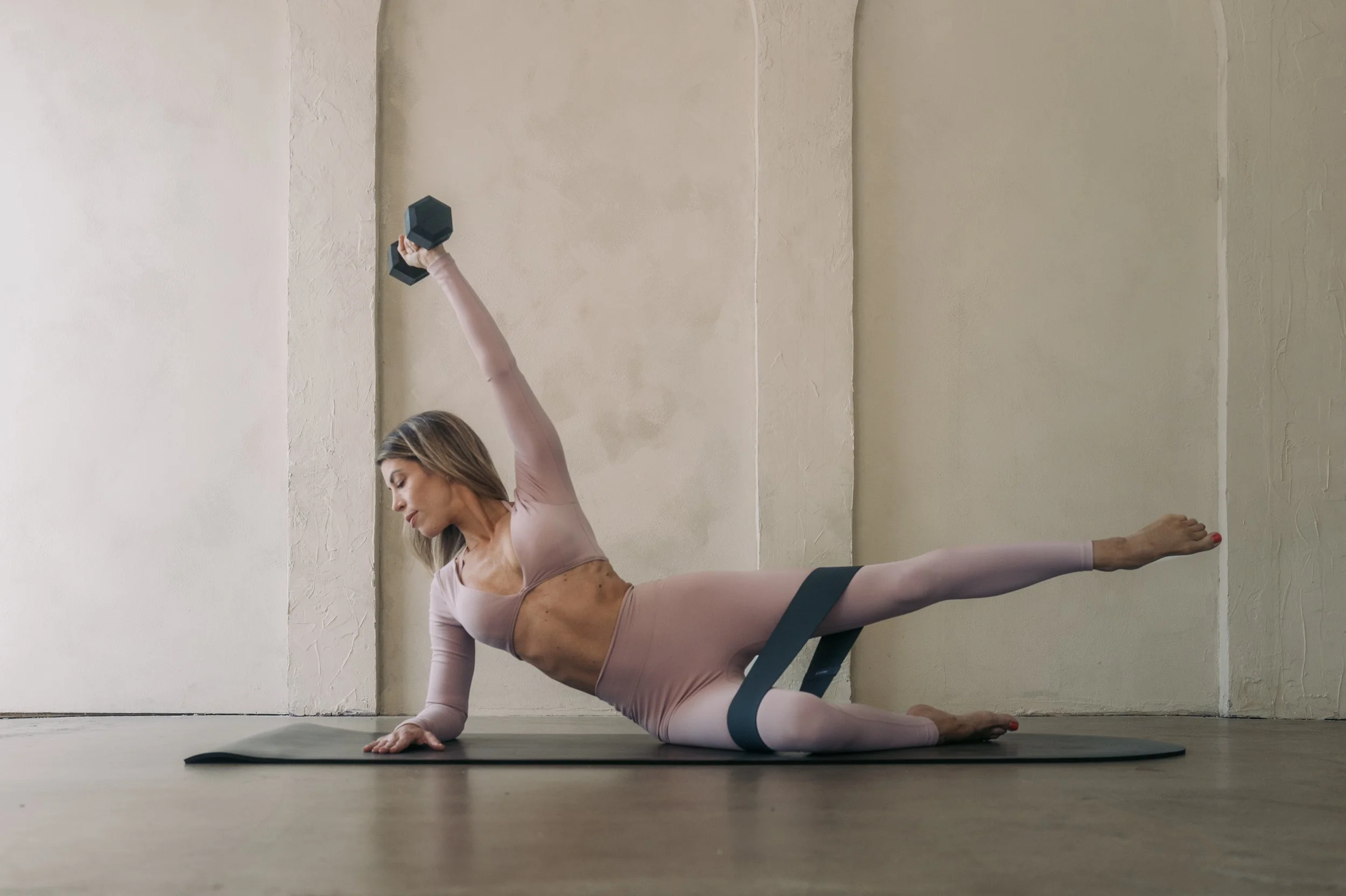
You don't have to choose between strength training and Pilates, and choosing one over the other means leaving real benefits on the table. Pilates builds core control, joint stability, and body awareness. Strength training builds the muscle mass and bone density that Pilates alone doesn't fully address. Together, they cover far more ground than either one does on its own.
I get some version of this question constantly, usually from people who've been loyal to one camp for years and are wondering if they're missing something. Reformer devotees who've heard they need to start lifting. Lifters who think Pilates is "too easy." Both groups are half right, and I say that as someone who is classically trained in Pilates and studied exercise physiology at Stanford. I've spent a long time thinking about where these two worlds overlap.
Is Pilates hard enough to count as strength training?
Classical Pilates, done well, is genuinely challenging. It builds a level of core strength, spinal control, and body awareness most strength programs don't touch, because most strength programs aren't built around that kind of precision.
Early in my career, I worked at a big, fancy gym in Los Angeles. The personal training manager, an ex-military guy in his late 20s with more muscles than I knew existed, asked me to train him in Pilates. During the Series of 5, a classical core series of five exercises that targets every zone of the core at 10 reps each, he stopped halfway through, completely fatigued. He looked at me and said, "You don't give other people this. You're being extra hard on me."
The truth? This series is taught in classical beginner mat and built on in intermediate mat. I have 80-year-old clients who do it. A few things added to his fatigue. More muscle means more weight to move. His form was beautifully connected, so his muscles were working efficiently, which means harder. And he was precise. He made it halfway.
So if you strength train and think Pilates is easy, you haven't been training with the precision your body deserves. And if you're a Pilates instructor who thinks adding heavier weight doesn't matter, your bones and body composition will eventually say otherwise.
What Pilates can't do on its own
Pilates, especially mat Pilates without added resistance, generally doesn't provide enough external load to build significant muscle mass or meaningfully protect bone density. That's not a flaw in the method. It's just not what it was designed to do. Strength training, real resistance work that progressively gets harder, does that job. (More on strength training and bone density after 40.)
How to combine Pilates and strength training
Instead of picking a side, use Pilates principles (core connection, controlled breath, spinal alignment) as the foundation for how you move. Then layer real strength work on top, so every squat, press, and hinge happens through a body that already knows how to stabilize itself.
That's the entire premise behind Merus Mat. It's not Pilates with a few strength moves thrown in, and it's not a lifting program that borrows a few Pilates cues for flavor. It's built from the ground up to blend both, because in over 20 years of teaching I've never found a good reason to separate them.
I've combined both in my own body, and I've never felt better. I sleep better, I'm more present with my kids, my fatigue has faded (I'll take muscle soreness over random drowsiness any day), and honestly, I've never felt more like an athlete.
Try the fusion: Start with a 30-minute Strength and Pilates plan or a 10-minute Stackable, free with your Merus trial.
Pilates vs. Strength Training: FAQ
Is Pilates better than weightlifting?
Neither is better. Pilates builds control, stability, and core strength. Weightlifting builds muscle and bone density. Combining them gives you the benefits of both.
Can I do Pilates and strength training on the same day?
Yes. Fusion workouts combine them in one session, and Pilates-based core work also makes a great warm up before lifting.
Does Pilates build muscle?
Pilates builds muscular endurance and strength, especially through the core. To build significant muscle mass, add progressive resistance like dumbbells or bands.
How many days a week should I do Pilates and strength?
Three to five days a week, mixing fusion workouts with shorter targeted sessions, works well for most people.